
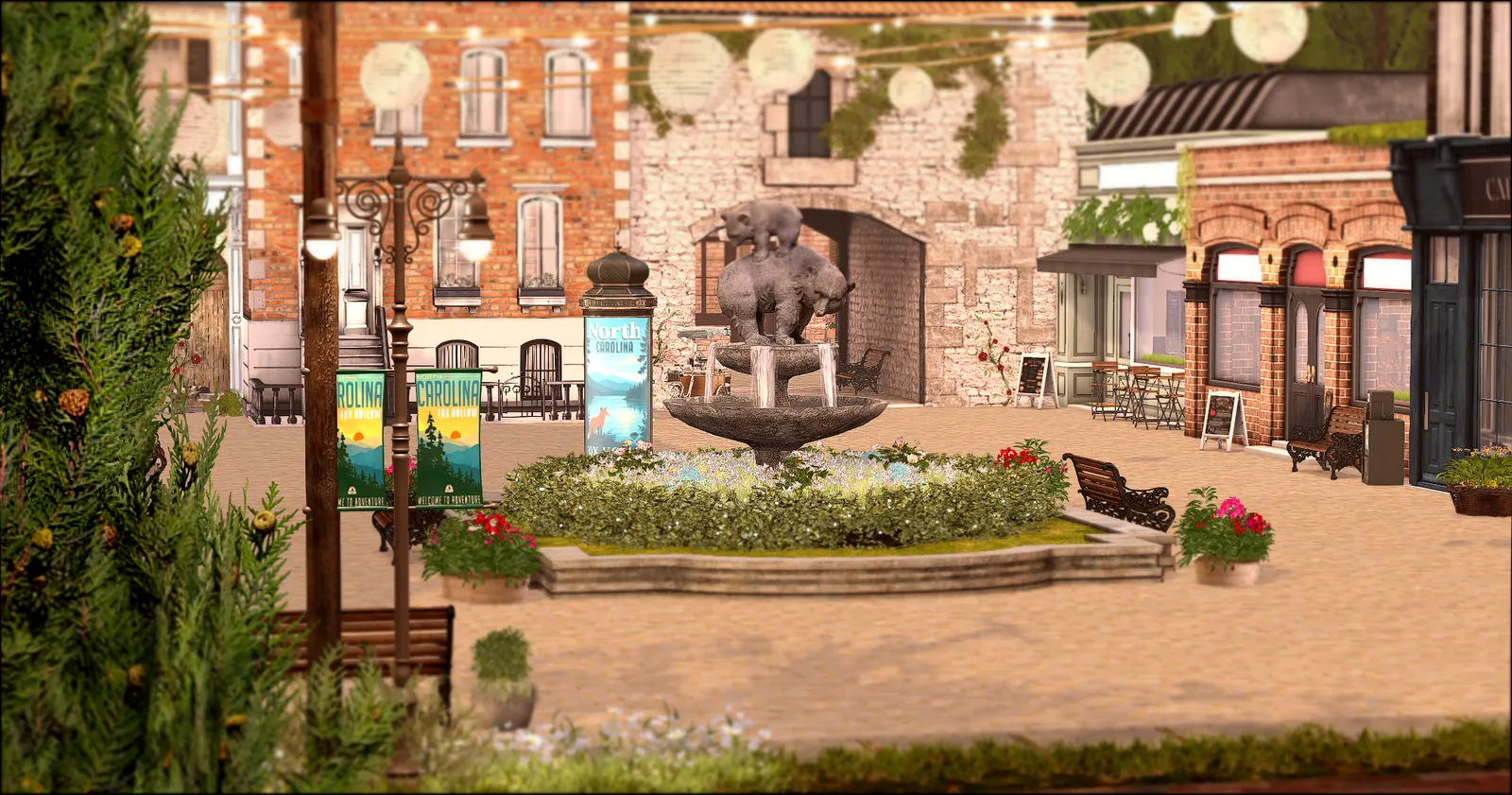
September 16, 1719 is widely regarded as the unofficial beginning of Fox Hollow, North Carolina. Following a season of devastating storms, flooding, and crop failures in the eastern Carolina settlements, a group of families led by Johnny McCoy decided to search for safer and more fertile land farther inland.
The settlers traveled west for several months, following rivers, old hunting paths, and trading routes through the Carolina wilderness. Their journey eventually brought them into the Blue Ridge Mountains, where they discovered a sheltered valley surrounded by thick forests, clear streams, and rolling foothills. The surrounding mountains offered protection from severe weather, while the valley provided enough open land for farms, livestock, and a permanent settlement.
The earliest residents established homesteads along both sides of the river running through the valley. Lumber from the surrounding forests quickly became one of the settlement’s most valuable resources. The area was also home to a thriving population of foxes, deer, black bears, raccoons, and other wildlife.
How the town got its name
According to local legend, residents argued for several weeks over what to name their growing settlement. The final vote came down to Fox Hollow and Raccoon Hollow. Fox Hollow won by only five votes, with at least three residents reportedly storming out of the meeting in protest.
Word of the fertile valley soon spread throughout the Carolina colonies. Families searching for farmland arrived from the east, while hunters, trappers, blacksmiths, and prospectors traveled through the mountains from settlements farther north and west. Rumors of iron, silver, and even gold deposits attracted prospectors to the surrounding ridges, although few ever discovered the fortunes they had imagined.
The Revolution, and a proper town
Despite its location near several mountain trading routes, Fox Hollow avoided much of the destruction and hardship of the Revolutionary War. Its remote position and difficult mountain roads discouraged large military forces from entering the valley. Residents still contributed food, horses, lumber, and supplies to the Patriot cause, and several local men served in militias throughout the Carolinas.
Following the war and North Carolina’s entry into the Union, Fox Hollow began to grow from a rural settlement into a proper mountain town. New roads connected the community to Asheville and other settlements throughout western North Carolina. Farms, mills, blacksmith shops, general stores, inns, and small workshops appeared along the town’s main streets.
Fox Hollow was officially incorporated on Wednesday, April 11, 1804.
Mills, furniture, and summer estates
During the early nineteenth century, the town became known for woodworking, furniture making, textile production, metalworking, and the processing of goods from nearby farms. Water-powered mills were built along the river and its surrounding creeks, allowing local businesses to produce lumber, flour, cloth, and other materials.
As Fox Hollow prospered, wealthy merchants and business owners began constructing large homes throughout the valley. The town’s mild summers, mountain scenery, and peaceful atmosphere also attracted affluent families from larger northern cities. Several built elaborate summer estates overlooking the valley, many of which would later become some of Fox Hollow’s most recognizable historic homes.
Jasper County
In July 1814, Fox Hollow and the surrounding communities formally became part of Jasper County. Local leaders hoped the creation of the county would establish clearer laws and provide better organization for the region’s farms, businesses, roads, and residences.
The county was named in honor of Sergeant William Jasper, a Revolutionary War soldier remembered for his bravery during the defense of Fort Moultrie and the Siege of Savannah. Jasper was fatally wounded by British troops while attempting to secure his regiment’s flag to the battle ramparts. Despite his injuries, he protected the colors until they could be carried safely away.
War, and the rebuilding after
Fox Hollow and the surrounding countryside witnessed several skirmishes during the Civil War. Troops moved through the mountains in search of supplies, rail connections, and strategic roads, occasionally clashing with local militias and opposing forces. Although several farms and businesses were damaged, Fox Hollow escaped the widespread burning and destruction experienced by many other Southern communities.
Following the war, the town slowly rebuilt. Mills reopened, farms returned to production, and new businesses appeared along Main Street. Visitors were once again drawn to the region’s cool mountain air, forests, lakes, and scenic overlooks. Boarding houses, inns, summer camps, and small resorts were established throughout Jasper County.
The mountain retreat years
By the late nineteenth and early twentieth centuries, Fox Hollow had become a popular mountain retreat. Residents enjoyed a growing local economy supported by tourism, agriculture, timber, textiles, furniture production, and small-scale manufacturing.
The town’s namesake fox population was nearly wiped out during this period as hunting became increasingly popular among visitors. In response, local conservationists petitioned the state to protect the forests and wildlife surrounding Fox Hollow. Their efforts eventually led to the creation of Copper Springs State Park, which preserved thousands of acres of woodland, mountain streams, and wildlife habitat.
The park helped establish Fox Hollow as a destination for hiking, fishing, camping, horseback riding, and other outdoor activities.
The lean years
The decline of American manufacturing during the 1970s and 1980s deeply affected Fox Hollow and the surrounding communities. Textile mills and workshops closed, jobs disappeared, and several neighborhoods fell into decline. Many of the town’s historic mansions and commercial buildings sat empty for years, while younger residents left Jasper County in search of work elsewhere.
Bringing Main Street back
Fox Hollow’s mayor worked with Jasper County officials, local business owners, and community leaders to create an ambitious revitalization plan. Rather than demolishing entire neighborhoods or replacing the town’s historic character, officials focused on restoring abandoned buildings, improving public spaces, and encouraging locally owned businesses.
Blighted properties were condemned and sold at affordable prices to individuals willing to renovate them. Buildings that could not be saved were carefully replaced with new structures designed to complement the town’s traditional mountain architecture. Residents displaced by the redevelopment program were offered compensation and assistance finding new homes within the community.
Town leaders also resisted proposals that would have divided Fox Hollow’s historic neighborhoods with large freeways and wide commercial avenues. State Highway 14 was instead constructed along the edge of the valley, with portions passing through tunnels beneath Juniper Mountain. The highway provided easier access to Asheville and the surrounding region without cutting directly through the center of town.
Polaris Road was later constructed as a connecting route between Highway 14 and Highway 214, providing access to Greater Jasper County, Juniper Mountain, and the rural communities surrounding Fox Hollow.
Fox Hollow today
Today, Jasper County continues to prosper. Fox Hollow is considered one of western North Carolina’s most desirable destinations for outdoor recreation, small businesses, and families searching for a quieter way of life.
The town’s restored Main Street is home to locally owned restaurants, shops, galleries, offices, and community spaces. Historic homes have been carefully preserved, while new neighborhoods have been designed to blend naturally with the surrounding forests and mountains.
The nearby community of Juniper Mountain has become home to many of Jasper County’s most influential residents, artisans, entrepreneurs, and small businesses. Its wooded roads and secluded properties offer privacy while remaining only a short drive from Fox Hollow.
Although the town has changed considerably since Johnny McCoy and the first settlers arrived in the valley, Fox Hollow remains defined by the same qualities that drew them there more than three centuries ago: sheltering mountains, abundant forests, clear water, close neighbors, and the promise of building a better life.